Welp, it’s over. And I survived. We’ll see in about 10 weeks if it was worth it.
Overall, it was an interesting experience.
The test itself was very stringently administered. Imagine going to an airport. You stand in line for a long time. You get through the door. You make sure you have your ticket and your government issued ID out and ready to be checked. “Walk through the door please!”, they say. Hold up your belongings. Are they all in a clear ziplock bag? They’d better be, otherwise they take them away. No cellphones during liftoff. No cellphones at all, you’ll get kicked off the plane in a second. Once you’re ready to disembark you need to wait for the attendants to finish checking. Everything. Thoroughly.
So what did I really learn? Something quite interesting:
I no longer plan to go to graduate school. (I had talked about possibly going back in a previous post)
That’s not really the subject of this post, I’d like to focus on that later, if at all. The short version is that I don’t think I am capable of the things that graduate school demands, at least from students who also work full time. Studying on a nightly basis, giving up all hobbies and time with loved ones; all of these things drive me away from the idea of getting an advanced degree. It’s not that I believe it wouldn’t help my career; I really just am not willing to give up my quality of life in order to get that particular piece of paper at this point in my life. Who knows? Perhaps there will be a time when it is truly required of me to have an advanced degree. However, from a learning perspective I feel that I would be forced to learn just as much–if not more–starting a company; plus that would be much more fulfilling in terms of having a similar time commitment and potential payoff (i.e. if I’m going to spend all that time, why not have a company instead of a piece of paper? Both look good on a resume, right?).
So back to the test. I had been studying for a month or so, perhaps a little bit longer in name only. I borrowed a used review book from a friend:
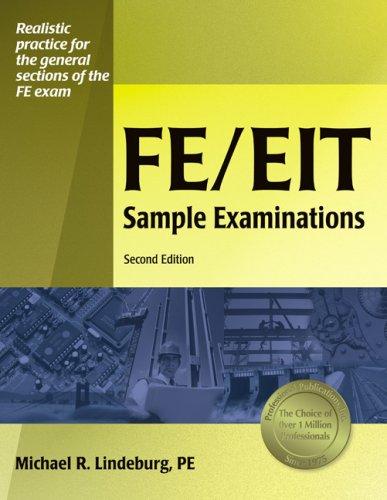
Everyone uses it, as I’m pretty sure it’s the only one out there. Want to know my personal/(possibly)professional (engineer) opinion? It was way overkill. 40 some odd chapters on every section that could possibly covered by the test. It went pretty deep about each and every topic, to the point that you might see the hardest question on the afternoon general section (the same range of topics as in the morning session, just more difficult). I think it’s important to note that depending on the year the testing board might throw one curveball after another your way or they might just keep lobbing softballs in your direction. Either way, you probably won’t need to learn (or re-learn) all of the material in the depth each chapter goes into with rigor.
Me? Well, I’m not allowed to tell you any details about the test itself. Our flight/test attendants were very sure to remind us over and over again that we were under non-disclosure agreements not to even talk about the test questions amongst our friends. What I believe I can say is that I enjoyed the afternoon section much more than the morning session. If you don’t know about the FE, the morning is 120 multiple choice questions spanning all of the knowledge that an engineer is expected to know after four years of engineering school. I would disagree. I would counter that the morning session is 120 questions for the mechanical and civil engineers. Now, it could be they have greater breadth in their respective disciplines, and even some crossover. It could be that being an engineer other than an electrical engineer requires greater cognitive capacity. Hell, it could be that I just didn’t study enough. But I’ll tell you, an electrical engineer such as myself has never known that much about beams, trusses or adiabatic systems…and never will! To add insult to injury, I think the EE questions were some of the softball-like questions on the exam. Let’s just say I probably had a much harder time with the mechanical/static stuff than the mechanical engineers had with electricity. Or maybe I just don’t care when a beam is going to start deforming irreversibly.
The afternoon session is 60 questions in your discipline, unless you decide you enjoyed the breadth of topics covered in the morning session or your particular discipline isn’t tested (BME for example). The section I decided to take was based upon electrical engineering topics, even expanding away from the typical circuits/power/E&M type questions into the DSP/communication/control disciplines (to all the NCEES people out there, this isn’t information that isn’t available in your lovely handbook). I definitely had to stretch my mind around some of the questions and even learn some before unseen topics while in the session. But that’s what engineering is really all about, right? In the end, if I passed the FE exam, I feel like these questions were much more in the direction I would have to take for the PE exam (to get final certification).
Would I do it again? Well, no, I don’t plan to (if I didn’t pass). I’m glad I tried it at least once. Does that make me sound like a quitter? Maybe. But I justify it as me not needing to be certified by a board that requires such stringent knowledge of beams. Ugh. Beams. Thank goodness there are people out there that enjoy studying and working with them. And that they’re certified to sign off that the beams won’t in fact bend.

16 replies on “Thoughts on the Fundamentals of Engineering Exam”
My first reaction: OMG! A post!
Second, best of luck. I hope you make it through.
Third, you’ve convinced me that I never want to take this exam. 🙂
1. No joke, it’s been a while.
2. Meh, I’ll be ok either way.
3. If you’ve gotten this far, you can do the FE. Remember, I didn’t like school. You seem to have a sick affinity for it!
I’ve had my Professional Engineer designation for more than a decade now. What has it gotten me?
1. Annual dues
2. The obligation to be ‘ethical’ (what a burden!)
The test is curved, so you probably passed it. Most people come out of there doubting, but more than half pass it. They grade it on a curve.
I prepared for the test by taking an online review class through the University of South Florida. The class consisted of ten 3-hour classes and several hours worth of recommended problems. I took ten full Saturdays to watch the class and work the recommended problems. This made the test pretty easy. I had the exact same experience with the PE.
My perception is any EE who is a) willing to give a solid 10 days of watching a review class and working the problems and b) doesn’t mind test-taking can pass these exams easily. It’s just a matter of finding the discipline to study.
I actually wish they made the PE exam harder to increase the esteem of PEs.
OK mr. Charles J Gervasi try the PE Structures 1 that is the SE1 and then let me know how easy it was.
Just check the pass rate every year.
TT, I think comparing the different sections of PEs isn’t correct. That’d be like comparing the pass rates of different colleges within a university. Only when the material is the same can the comparison truly be made about how easy or difficult something is.
well!? did you pass?!
Yup! I’m officially an “engineering intern” in Ohio now.
Hello,
I plan on taking the FE in October and found your website.
Do you know where I can get copies of old/ past FE exams? Provided that they are available.
Also, do you have any study tips that you would like to pass on?
Thanks
The FE questions are closely guarded. You’ll see it when you take the actual exam, they make sure nothing makes it out of the exam room. That being said, there are lots of practice books out there that are helpful and have “representative” questions. I think the books are a bit of overkill (the questions are too hard for the actual exam), but it’s better to be over prepared rather than under. Good luck in October!
I thought the morning questions were WAY less painful than the afternoon ones (being an EE). The afternoon electrical section just kept pounding me with questions that I either a) took the class in 2 years ago and forgot or b) never learned in any of my classes.
The review book is total overkill though. The engineering economics problems on the actual test are MUCH easier to figure out, for example. The review book has you thinking you need to be an accountant to do well.
After passing this exam in October 2012 I can only say one thing. Do not wait. Take the exam while still in school or you will be going through some tough time. I took the exam after being out of school for 20 years and it took me three attempts until I passed. I can give potential test takers these ideas:
1. Take this test seriously. I have heard students selling stories they have prepared one night before test after coming home drunk from party previous night etc.Do not fall for that. Those probably never took the exam anyway. Study for this test. Make sure you are very good with subjects you have strong background in.
2. If you are still in school I would definitely suggest you to take general exam in the afternoon. Discipline specific exam in the afternoon is hard for those who do not deal with those type of problems daily especially civil afternoon section.
3. Time is of the essence. Make sure you are aware of time. First time I took the exam I remember proctor saying “you have one hour left” and I only solved 50 problems out of 120. I did not even leave some time at the end of the exam to answer rest of the questions (I probably left 30-40 questions unanswered). If you do not know how to solve the problem in the first 30 seconds, move on and then come back. First solve those problems you are sure you know how.
4. Some sections such as computers and ethics are there to strap you of your precious time. For example some ethics questions take 2 minutes read through the question and get the sense what they are asking for. They are easy to answer but takes some time to put 2 and 2 together. Leave them for the last hour.
5. If you are out of school for some time you will probably need review class for the morning session. Go to http://www.ppi2pass.com website they have the best selection of books you will need to put this exam under your belt. The one I found the most helpful was Civil afternoon exam specific questions. I think those questions saved me.
Hope this helps everyone planing to take this exam and good luck.
I would like to hear all of your thoughts on whether or not it is worth taking the FE if I don’t plan to ever try to obtain my PE. I am a senior in Mech. Engineering and will graduate this coming May. I have a job lined up, and have held several internship positions throughout college. I am curious to what benefit I might gain by taking the test. I see that Fluxor had left a comment above saying that he/she has been considered a PE for more than a decade now and doesn’t make it sound as though it has made a huge impact on his/her career. Anyway – I would like to hear your thoughts, as I am debating whether or not it is worth the time and effort of taking the FE.
I just got my result. I pass after 11 years out of school. yessssss
I just took the FE: Electrical and Computer science. It was the new format that is on the computer only.
I took the test 1 month before graduation from a very rigorous engineering school. I had never taken any class on computer organization or modeling but I had seen everything else.
I was able to pass without much more than reviewing the FE handbook (PDF with all equations and tables) for 2 hours the night before.
If you have confidence in your education and yourself, the FE is a very passable test.
Yes the FE & PE tests are a must. I order to get your engineering SEAL. This test is your (respect, self esteem, credibility, financial compensation), you owe it to yourself & you kids unborn.
Don’t let no one belittle you at work.
Study and pass. Leave fishing, clubbing, hunting, etc.. For a while till you pass. When you pass. Then you can live your life with the respect u deserve.
Good luck to you all.
Sam J.