How does an op amp work? How do I use an op amp
These are questions that I have asked at two periods in my life. The first time was in my introductory circuits class and around that time I really didn’t care (beer was a priority). The second time was when I dove headfirst back into analog electronics for my new job and had to re-teach myself a lot of things. I really appreciate the opportunity I had to re-learn everything because the second time around, I think I got it right.
OK, so let’s start simple. What is an op amp? Whoa, loaded question. For our purposes here (and just for now), let’s say it’s just a symbol.
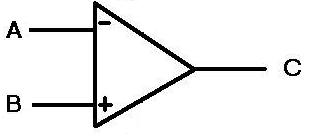
To keep things basic, the A & B points are the input, the C point is the output.This symbol is an IDEAL op-amp, meaning it is impossible to construct one and really the expectations for the op amp are unrealistic. But this is the internet and we can do what we want on the internet, so we’ll just use the IDEAL op-amp for now.
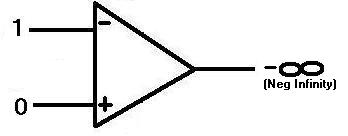
OK, so now you know what the symbol is, but what does it mean? Well, the idea is you put two electrical signals into the inputs then the output changes accordingly. It takes the difference between the inputs and amplifies it, hence operational amplifier, or op amp. You may have noticed that input A has a minus symbol and input B has a plus symbol. So let’s say that the input to the minus, or INVERTING, input is 1 (for simplicity’s sake…this site is about analog so that value could be ANYWHERE from 0 to 1 or higher! Just thought I’d mention that). The input to the plus, or NON-INVERTING, input is 0. Now the op-amp is in an unbalanced state. The device is designed so that when this happens, the output goes as negative as it can. For the ideal case, we say this is negative infinity, but that’s not really possible. More on that later.
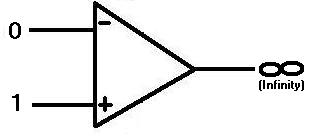
Conversely, in figure 3, if we put a one on the non-inverting and a zero on the inverting input, the op amp output would go high, infinity for our purposes here. The important thing to know is this:
The op-amp always “wants” both inputs (inverting and non-inverting) to be the same value. If they are not, the same value, the op amp output will go positive or negative, depending on which input is higher than the other.
(Throughout this article I will continue to anthropomorphize op amps…best to get used to it now)
Alright, so how do we use this in circuits? If we wanted to find out if two signals were different, we could tie the signals to the inputs of the op amp, but then the output would go to infinity. This would not do us any good. The answer to this and many other questions in the universe is feedback. We are going to take the output and tie it back to the inverting input. Now the circuit looks like this:
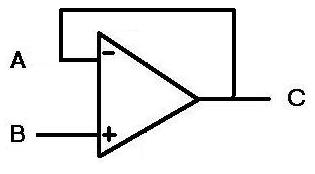
First, we assume that the circuit has all points start at zero (point A being the most important). Next, we put a value of 1 (like the picture in figure 2) at the “B” non-inverting input. “WHOA,” says the op amp, “THIS AIN’T RIGHT!” So now the op amp puts its output to as high as it can, as fast as it can. This feeds back from the output (“C”) to the inverting input (“A”). So as the output moves closer to 1, the op amp is happier and backs off the output. When the input at A is the same as at B, the op amp is happy and stays there (but maintains the output of 1). The key here is that the op amp moves as fast as possible to get both inputs to be the same.
Why would someone use a buffer? Well that brings us to the next point about op amps, specifically ideal op amps:
Ideal op amps have infinite impedance (resistance) at their inputs. This means that no current will flow into the op amp.
A common use for a buffer is to supply current to another stage of a design, where the buffer acts as a gateway. So when the buffer “sees” a voltage at the input (“B”), it will output the voltage at “C”, but will also drive that voltage with current (as much as you want for an ideal op amp). This would be useful if you have a weak signal at the input, but want to let some other part of a circuit know about it. Perhaps you have a small sensor that is outputting a small voltage, but then you want to send the voltage over a long wire. The resistance in the wire will probably consume any current the sensor is outputting, so if you put that signal through a buffer, the buffer will supply the necessary current to get the signal to its destination (the other end of the wire).
What if the signal coming from the sensor is too small though? What if we want to make it bigger? This is when we turn the op amp into an amplifier, using resistors. One of the more common ways of doing so is using the inverting input, shown below:
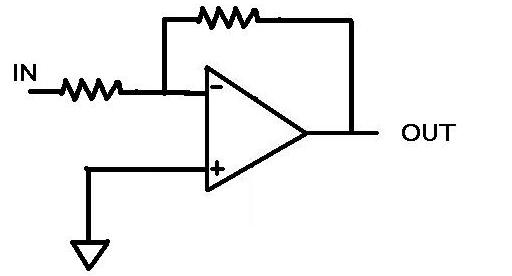
Let’s go over what we know about this circuit. We know that the op amp wants both inputs to be the same. We also know that the non-inverting input is zero (because it’s connected to ground) and so the op amp will want the inverting input to be equal to zero (sometimes known as a “virtual ground”). In fact, since the op amp has feedback through the top resistor (squiggly line if you didn’t know), then the (ideal) op amp will output just about any current and voltage in order to get the inverting input to be equal to zero.
So now our situation. A dashing young engineer hooks up a voltage source to the point “IN” set to 1 volt. This creates a voltage at the inverting input. “WHOA” says the op amp, and then it begins to output a voltage to make the inverting input point equal to zero. Since the input is 1 volt the op amp decides it better do the opposite in order to make the inverting input match the non-inverting input of zero. As fast as it can (infinitely fast for an ideal op amp), it outputs -1 volt. The inputs are both zero and everything is right in the op amp’s world. What about current though? We remember that current cannot flow into the op amp at the inverting input, so any current will be flowing through both resistors. If we have 1 volt at the input and a 1 ohm resistor at the input, then we will have 1 amp of current flowing (according to Ohm’s law V=IR). So when the op amp outputs -1 volt across the top resistor, there is a -1 amp going through it (assuming it is a 1 ohm resistor). The currents cancel each other out at the inverting input and the voltage then equals zero. The place where the currents meet is sometimes called the “summing node”. This is a useful representation when dealing with currents as opposed to voltages.
For the last part of this thought exercise, let’s look at a situation where the resistors at the input and at the top of the circuit are not the same. Similarly to above, the same dashing young engineer puts 1 volt at the “In” node. The resistor is still 1 ohm, so there is 1 A of current flowing through to the summing node. The op amp once again sees this 1 volt and once again says “WHOA, I’m unhappy about this” and starts outputting the highest voltage it can. However, in this situation, the top resistor is now 4 ohms. In order to create the -1 amp that is required to cancel the 1 amp going through the input resistor, the op amp must output -4 volts (remember V=IR). We see that for an inverting op amp configuration, the ratio of the resistance of the top resistor to the bottom resistor determines the gain, or a multiplication factor from the input to the output. Also notice that the output is negative for a positive input, confirming that this is an inverting amplifier.
That’s the basics of it. Check back here for more about op amps, because there is a lot more to be said. Future posts might include other op amp configurations, design considerations and even the dreaded “REAL WORLD”, where the ideal op amp no longer exist.
[xyz_lbx_default_code]

80 replies on “How does an op amp work? How do I use an op amp? — Part 1”
So why does it have to be a dashing young engineer? Couldn’t it be an old, grumpy engineer or a ravishing goddess?
BTW, I didn’t realize you work for Keithley. You rock. 🙂
cool
Just a quick question about the inverting and non-inverting inputs of an op amp…
In the buffer example if the + and – were swapped (ie out connected to + and B connected to -) would it perform exactly the same?
The same goes for inverting and non-inverting amplifier circuits.
In every example ever, the are always connected in the above way. I guess that might just be convention, but it should still function exactly the same if + and – are switched around right…?
No it wouldn’t. In that case the output would saturate.
Hey John,
That’s a great question. I guess I should have been a little more clear on the idea of feedback. There are two types of feedback, positive and negative. Negative feedback will help to control systems, while positive feedback will often put systems out of balance (think Jimi Hendrix wailing on his guitar…that’s the amplifier positively feeding back to his guitar pickups). In the situation of the buffer explained above, it is negative feedback (see http://en.wikipedia.org/wiki/Negative_feedback).
Think about it like this. In figure 4, you see the input to the buffer is the positive (non-inverting input) and the feedback is the inverting input. Say those are switched. Now you put 1 volt on the input (inverting). The op amp will want to output -1. This will then feed back to the non-inverting input and the op amp will see a 2 volt difference between the inputs (1 at the inverting minus a -1 at the non-inverting). The op amp wants to see no difference so it “pushes” even harder. Eventually this situation will spin out of control and the op amp will be outputting minus infinity (for an ideal op amp).
The connections definitely matter and I will try to discuss that further in future posts.
Hope that helps!
~Chris
[…] Stuff How does an op amp work? How do I use an op amp? Part 1 Aug […]
[…] As promised, this post is a follow up post to explain the real-world behavior of an op amp. Here we will continue to anthropomorphize op amps in order to better understand their behavior and what they “want” to do. Also, we will look at some more complicated (but common) op amp configurations so that they are easily recognizable. Let’s begin. […]
I want the difference between +ve & -ve feedback of op-amp.
i dont understand your question…isn’t the difference going to be what ever your input voltage is….as in what ever your voltage source is?
Well I always wanted others to do my homework when I Googled on the subject too, but it didn’t always work out :-). Check my contact page and shoot me an email if you still can’t figure out your problem.
[…] in technology because of its innovators. These best and brightest minds created everything from electronic building blocks to the computers in which they were utilized. And now we’ve seen not only jobs going […]
[…] school that encouraged me, especially my high school physics teacher that inspired me to go into engineering. To all of my friends that are kind enough to click on my blog on a regular basis and give me great […]
[…] do things that are better than others. One example might be teaching a newer employee how to best measure the current of an op-amp. The new employee might have TONS of ideas of how to do this (probe the voltage across an output […]
Thanks for explaining op-amps, I have a question on how the op-amp creates the voltage and current needed to amplify the input? Is it from the DC voltage that powers the op-amp?
Thanks,
Mike
If I only went to your 2nd part of your tutorial before I asked question about the power needed..
Mike
[…] and endorphins reaching my brain are telling me that it’s ok to keep reading a paper on an op-amp or whatever I happen to be […]
[…] How an op amp works — I set the op amp apart from the passives because it is an active component (duh) and because I think that it’s so much more versatile that it’s important to set it apart conceptually. I’ve always had the most luck anthropomorphizing op amps and figuring out what state they “want” to be in. Combining how you conceptually think about op amps and passives together can help to conceptualize more difficult components, such as active filters and analog to digital converters. […]
Thank you Dan, I fixed it in the text. Good catch (and interesting metaphor)!
hi chris , I want to ask you something , I have designed an Op Amp circuit using LM741, i need to write a report for my tutor about what if you implement the circuit in real life , what would happen ?
THanks alot
In the text under figure 4, you state:
This feeds back from the output (”C”) to the non-inverting input (”A”).
I think input A is the inverting input on that figure.
Just trying to clarify in case someone comes along & is confused when the carpet doesn’t match the drapes.
what is the meaning of inverting and non-inverting input?
Nice! I’m studying for an exam paper which is all about op amps etc. and i find it so difficult to understand (so does everyone in my class), but after reading this, i finally get the basics of an op amp! The rest of this paper is starting to make sense now! lol. Thank heaps Chris! Great site!
Hi I am a new engineer working in a Japanese electronics company. I am glad I found your site. It is really insightful 🙂
[…] in light blue). However, as stated before, nothing is perfect. The bandwidth of the chip (the op-amps and other controlling elements within the chip) are finite, so there cannot be perfect control. […]
[…] resistor value of a circuit board they encounter. And mess with the capacitors. And change the model of the op amps. Oh, and don’t forget to swap out transistors. “What?? It still doesn’t work? But […]
Good stuff – I work in the power field of EE and am constantly amazed at how much non-power information I have forgotten!
Thanks mike! You have no idea how much this meant to me when I’m doing my panic revision =) All the best!
[…] components). And believe me, there are a lot more complicated things one can use an LM317 for. An op amp might have show a photodiode amplifier if it operates well with high impedances and a transistor […]
i think that we r not cleare understanding yet now about op-amp working
thank you for explaining about negative feedback
[…] of a project before you make costly design decisions. You can realize not to use a particular op amp or even decide if a project is feasible at […]
HELLO rockers!!!!!!its jst d superb way of practical kind of explanation CHRIS…i m jst passsed out & belive me never did i got op-amo so well…tht made me hate ANALOG…….
[…] for their latest projects. In fact, I’ve tailored some of my own more popular posts (about how op amps work) towards teaching people in certain niche areas. Some of the best sites out there (such as […]
[…] current — We all know that in an ideal model of an op amp, you assume there is no current flowing into the inputs terminals. Well, that’s never really the case, and having any current flowing into the terminals can […]
this has fried my brain yes… now i gotta ask in my logic and using fig4 when input b is 1 and input a is 0 then the op amp makes its output infinity. now that makes input a to go infinite which is bigger than 1 volt causing the op amps output to go to negative infinity and so on… does it quickly level out because i have no idea how this works. you see the book im reading is for brains that dont seek full explenations
[…] They detect the voltage directly at the device without drawing much current (likely by utilizing high input impedance op amps). So the current that is powering the remote device will be sourced through one set of wires and […]
can I use opamp741 instead of 333171?
[…] it often correlates to higher cost components. Not only will you need larger packages for your components such as op amps and comparators in order to better dissipate heat. You’ll also need a larger power supply with more […]
i agree but not satisfid with u and ur all question
why amphlipher shift phase by 180 degree anglee
Thanks for this explanation. was searching for this type of explanation on op-amps from 5 days. and finally your site gave me goose bumps. am so damn happy 🙂 🙂 U ROCK
one more request, would be happy if you could post about input and output impedance.and how they are necessary, and how are they found in different configurations of transistors.
thanx again
Why inverting mode of operation in OPAMPs is mostly used in circuit design?
OOMIGOSH! Not the dreaded “REAL WORLD”! Please No….PLEASE!!!!!
thanx man
can you explain something about lcd programing on MC?????
[…] First, let’s define some terms for our student readers, who have not yet been introduced to the world of being sold components. Throughout the examples, I’ll pretend we’re talking about designing in an op-amp for a new product: […]
[…] too (saying all in brief). Below is a link which can give you an extended lessons on OP-AMPS. How does an op amp work? How do I use an op amp? | Chris Gammell's Analog Life Hope it helps. Reply With Quote View Profile + Post New Thread + […]
[…] there aren’t many ways to read these aside from a computer. When I need to really dig into the theory of operation of a part or an application note, I don’t want to be sitting upright in front of a computer for hours […]
can you please tell me.what is the use of op-amp in low pass and high pass filter if the combination of RC perform the filtering action?
thank you ,,,what of application of op amp
Finally some clear explanation. YouTube vids wasn't helping me at all with their boring voices 😀 This was much better
Hi Chris! Thank you a bunch for this article, it has helped me get a much better understanding of the ideal op amp.. I know the ideal op amp is a fictional thing, but you need to crawl before you can walk 🙂
Hey there Chris,
I was reading your article and I was wondering why does the following happen: “So when the op amp outputs -1 volt across the top resistor, there is a -1 amp going through it (assuming it is a 1 ohm resistor). ” how does the op amp produce an output of -1 volts ?
And what did you mean by the non inverting input of the op-amp cannot have any current flowing in the flowing: “We remember that current cannot flow into the op amp at the inverting input, so any current will be flowing through both resistors. ”
Thank you ,
Rasna
WHAT DO THE STATEMENT (HIGH OPEN LOOP GAIN ACTUALLY MEAN
I’m a little new to some of these electronic components and I never understood Op-Amps until now. Basically what I got from this article is that it takes two current sources at the two pins and gives off one current source at the third pin and the third current source is the difference between the first two. Am I understanding it correctly?
Great post! It’s currently helping me understand the class I’m taking.
Great Intro text.
I’d like to thank you (being Greek) for the “anthropomorphize” word you used, although “a dashing YOUNG engineer”. Keep up the good work.
Nikos
What makes an op-amp amplify? How does it achieve the gain of 10 exp5? Is it from power considerations meaning that the output current diminishes 10 exp 5 times?
hey chris, this is really awesome way of explaining…. its been more than 1 year, i couldn’t find the exact working of opamps but u made it much much easier… thanx alot. is there any other things regarding these devices u’ve xplained over here. plz just let me know i’m curious to see them all.
Great! thanks for the wonderful explanation 🙂
Thanks dude!!! helps a lot!
Thats a concept well explained. Thanks!
[…] (op-amp) are using for gain this means if it will increase your AC input voltage but an important issue is […]
[…] the math matters (really, it does). And learning about the equations behind resistor dividers or op amp circuits does a lot for students’ eventual need to solve problems. But why were we learning it? What […]
This is one of the best explanations of basic op amp theory I have read. Thank you. I am beginning to get it.
Really an clear and thorough explanation, you should open the next Khan Academy!
what if the opamp does not have resistor?
only capacitor and transistor
how to calculate the gain?
Thank you, doing homework for my son! I am point him to your website. Very clear.
And to think that I came here to copy everything so as to please my lecturer.Thanks a lot man,I finally got to understand this,and please my lecturer at the same time 🙂
What are advantages of Non-Inverting Amplifier?
I bow before you. Thank you so much
Really usefull post.I need part 3 and part 4.Where i can get it?
Thanks for this tutorial – this made op-amps much easier to understand than when I looked at different sources.
I’m a fan of the reaction that the opamps have to the voltage. I feel that I’m going to be very disappointed someday when I get a chance to just fiddle around with them and it’s silent.
Finally an explanation that makes sense
You should teach because this tutorial is excellent.
Thanks Chris. A great article written with a sense of humor. Enjoyed it.
hi there,
there were good points here that were really usful. certainly the “buffer” section.
thanks a lot,
ome
I don’t know if it’s the 4 weeks I already spent studying opamps but you’re explanation is great! Highly recommended for anyone trying to understand opamps!
Thanks for the article but it is very complicated to read for a noob!
Why we go for opamp if we have transistor